
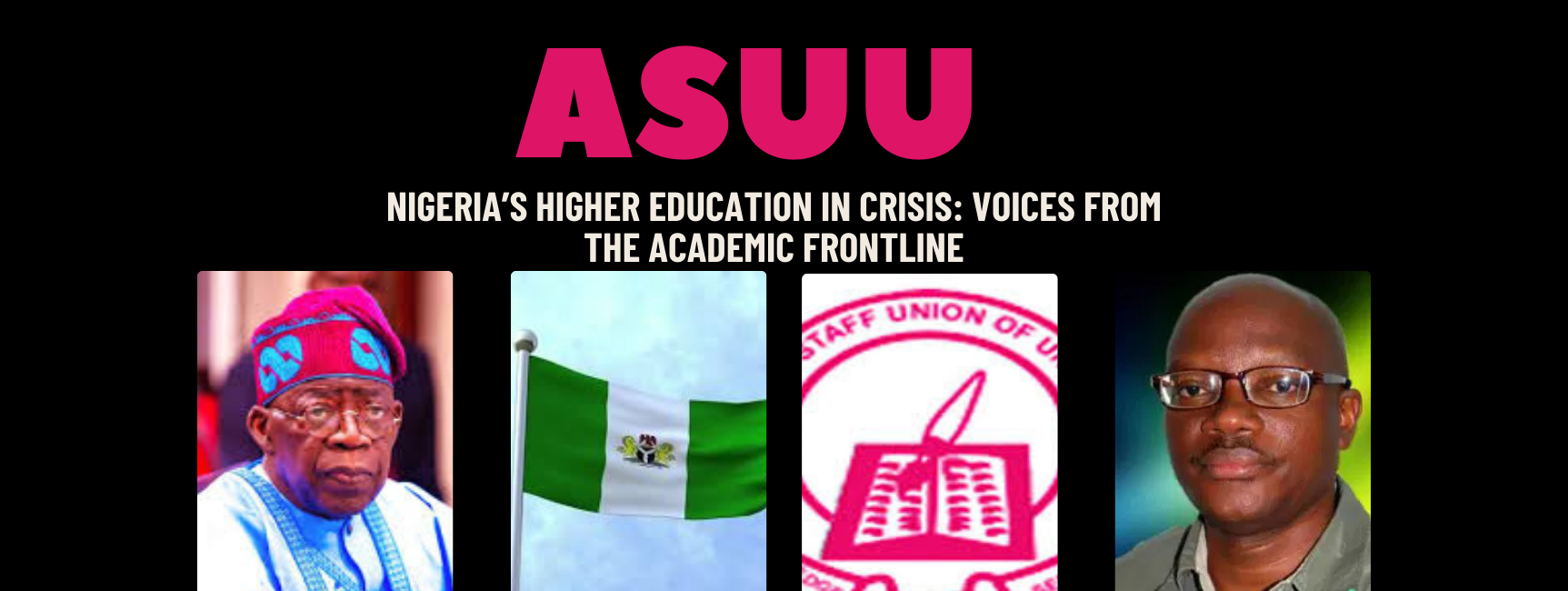
❝In Nigeria today, classrooms are no longer places of knowledge—they are reminders of neglect.❞
When Prof. Chris Piwuna took the microphone for his very first press briefing as President of the Academic Staff Union of Universities (ASUU), he didn’t sound like a man settling into a new role. He sounded like a man warning a country teetering on the edge of a quiet, intellectual collapse.
His voice wasn’t angry. It was weary.
Weary from years of watching promises made in shiny government halls fade into nothing but empty headlines. Weary from seeing brilliant lecturers—mentors and minds—struggle just to survive. Weary from watching a system that was built to empower the nation’s youth slowly turn into something that weakens them instead.
And yet, with that weariness came fire.
“If we do not fight for our universities today, there may be no universities left to fight for tomorrow.”
A Nation’s Future, Hanging in the Balance
“Nigeria’s educational system is in crisis,” Prof. Piwuna declared. But his words weren’t just a headline—they were a mirror held up to a society that has, for too long, looked away.
At the heart of his concern was the ongoing decay in university education. It’s not just about underpaid lecturers or dilapidated classrooms. It’s about a national culture of silence—one that allows broken promises to linger without consequence.
Prof. Piwuna pointed to the 2009 FGN/ASUU Agreement, a document that was meant to reform Nigerian universities and improve the welfare of those who teach. Since 2017, efforts to renegotiate that agreement have been stalled like a car with no fuel—and no driver in sight.
The Issues That Won’t Go Away
Here’s a hard truth: some issues have seen partial attention, but most remain abandoned. These include:
-
✅ Renegotiation and signing of the 2009 Agreement, based on the Nimi Briggs Committee’s work
-
❌ Payment of withheld salaries following the 2022 strike
-
❌ Unpaid earnings for sabbatical, adjunct, and part-time lecturers, lost in the maze of IPPIS (Integrated Payroll and Personnel Information System)
-
❌ Release of third-party deductions like union dues and cooperative contributions
-
❌ Earned Academic Allowances (EAA) that remain unpaid and unacknowledged
The deeper you look, the more painful it gets.
Cracks in the System, Cracks in Trust
Nigeria’s educational problem is not just under funding. It’s under-prioritization.
It’s the slow but steady message sent to lecturers that their service isn’t valued. That promises—even written ones—are just for press conferences and political optics. That intellectual labor can be delayed, ignored, or erased without apology.
No nation ever thrived by treating its thinkers as afterthoughts.
Prof. Piwuna’s message wasn’t just for government officials. It was a call to every Nigerian—student, parent, teacher, policymaker—to stop treating education like charity and start treating it like the lifeblood of the country.
Why This Matters—To All of Us
When lecturers are owed salaries, they lose morale. When academic allowances are unpaid, departments stagnate. When public universities are left to rot, private ones thrive—and only the privileged can afford quality education.
The consequence?
A deeper divide between the educated and the excluded, between hope and hopelessness, between those who rise and those who are left behind. Prof. Piwuna ended with a message not of despair, but of quiet resistance. ASUU, he said, remains committed to defending the Nigerian university system, no matter how long it takes.
This isn’t just a fight for salaries. It’s a fight for integrity, equity, and a future where education is not a luxury—but a right.
